

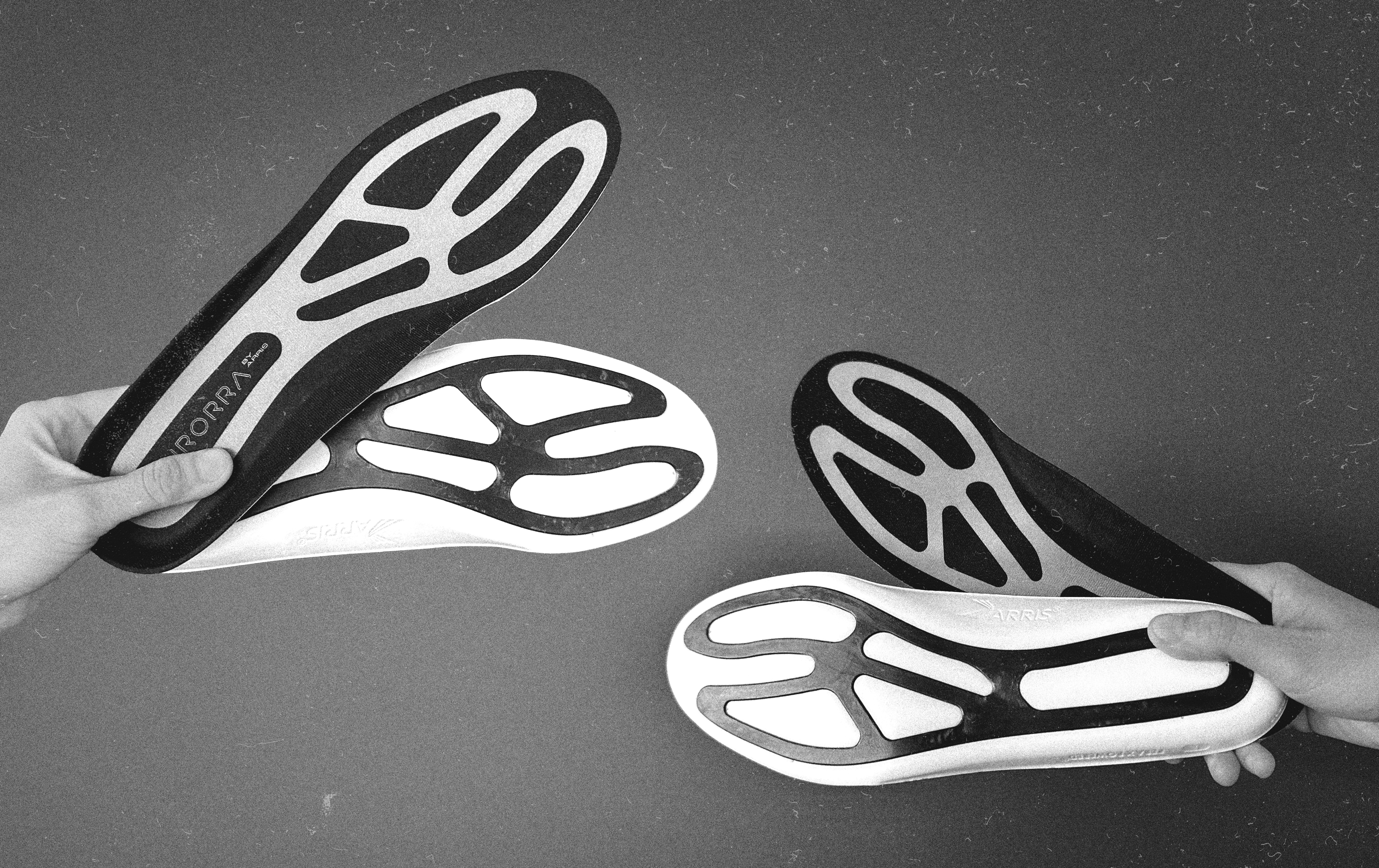
In short... Carbon fiber super insoles can improve the feel and performance of almost any running shoe.
- In non-plated shoes, super insoles add stiffness and responsiveness for a more energetic ride.
- In plated shoes, super insoles enhance the existing plate effect for an extra edge.
Whether you're training or racing, they're a simple way to get more out of your favorite shoes... read on for the data and testing that back up these findings.
The Results of Adding Pebax Powered® Super Insoles Featuring ARRIS® Carbon Fiber Plates to Running Shoes with & without Existing Midsole Carbon Fiber Plates
Runners are naturally curious, and they ask good questions (we love that). So, these are the two most common questions runners often ask the AXA team.
- What happens when you add a carbon fiber super insole to a shoe that already has a plate (read here for more on super shoes)?
- How does that compare to a shoe that doesn’t have a plate?
Whether a shoe starts with a plate or not, the ARRIS carbon fiber super insole increases overall stiffness by 10–15 N/mm. Here’s what that means in real terms.
Stiffness Gains: Unplated vs. Plated Running Shoes
Even though both setups gain the same absolute stiffness (10–15 N/mm), the percentage change is very different.
For example, shoes without a plate have an average 70% increase in stiffness.
In lab tests, a popular running shoe (“Trainer A”) without a plate measured 17 N/mm of stiffness. Drop in the AURORRA by ARRIS Carbon Fiber Insole and that same shoe jumps to 32 N/mm — an 88% increase that puts it within 11% of a major-brand super shoe we measured at 36.4 N/mm. That’s what we mean when we say our insole gives everyday shoes a super-shoe-inspired lever (one you can take in and out whenever you want).
As another example from lab testing, a new-to-market running shoe (“Trainer B”) without a plate saw a 46% increase in stiffness, landing it within 4% of that same super-shoe benchmark.
Shoes with plates have an average 50% increase in stiffness.
The team tested a newly released super shoe built with Pebax foam and an ARRIS carbon-fiber plate in the midsole, then added our carbon-fiber insole (also paired with 100% Pebax). Stiffness jumped by 42%. That’s what can happen when you double-stack plates the right way — more lever, more efficiency, more pop underfoot. In other words: Non-plated shoes can feel dramatically different. Plated shoes gain an additional performance edge.
Why Stiffness Matters: The 1% Oxygen Cost Savings
Independent research backs this up.
An increase in stiffness of 10–15 N/mm, the kind you get from ARRIS® carbon-fiber plates, has been shown to reduce oxygen cost by approximately 1% (see “Notes & Sources” below). To put that into perspective: 1% can be the difference between a 3:00:00 marathon and a 2:58:00 marathon. That’s meaningful.
Turning a Regular Trainer Into a Super Shoe
Because stiffness is such a defining feature of super shoes, adding our plate can shift a typical running shoe into that zone.
Example: The trainer noted above jumped from 17 N/mm to 32 N/mm with an ARRIS carbon fiber plate, squarely in the stiffness “sweet spot” associated with super-shoe performance (i.e., the range researchers associate with improved running economy).
Yes... Adding the AURORRA By ARRIS Super Insoles with Pebax supercritical foam and ARRIS carbon fiber plate to your running shoes is meaningful, whether or not you already have an existing propulsive plate.
But What If the Shoe Already Has a Plate? Is Double-Stacking Too Much?
Adding our plate to a plated racer does not push the shoe into the “too stiff” danger zone. But why?
- The combined stiffness remains within the proven energy-saving range
- And stays below the 40 N/mm over-stiff plateau reported in the literature
- Added stiffness can actually improve running economy by up to another ~1%
So instead of “too stiff,” you get super-shoe-level stiffness with added mechanical advantages. Think of it as optimizing the lever, not overloading it. Still, numbers only tell part of the story. Comfort and feel are personal, and for some runners, a double stack may fall outside their sweet spot. Plenty of runners don’t love plated shoes to begin with — let alone a double-plated setup.
Why Two Plates Can Make an “Illegal Shoe”
Two plates aren’t redundant — they can work together if engineered correctly as a sandwich structure.
1. Dual Curvatures Can Improve the Ride
By giving the two plates different curvatures or thicknesses, you get:
- A softer, more forgiving first flex at mid-stance
- A stiff, efficient forefoot lever at toe-off
This is similar to leaf-spring suspension (see “Notes & Sources” below).
2. More Energy Comes Back
When foam is trapped between two rigid layers, it deforms more elastically than foam pressed against a single rigid layer.
Result: More of the compression energy returns, and less is lost as heat.
Early mechanical tests on dual-plate prototypes show approximately 3% higher rebound than single-plate controls at the same stiffness.
That means the shoe feels snappier without feeling harsher.
Long Story Short
However you lace up, here’s what the findings reveal about adding our carbon fiber-plated insoles to shoes with and without plates:
- AURORRA by ARRIS Carbon Fiber Super Insoles add 10–15 N/mm of stiffness
- Unplated shoes can see massive gains (around 70% on average)
- Plated shoes still see meaningful upgrades (up to 50%)
- Both setups land inside or near energy-saving stiffness ranges
But numbers are only part of the story. The most important factor is still how you feel in your shoes. Try a few combinations and listen to your body. Some runners love a super-stiff setup, others prefer a lighter plate feel, and some want no plate at all.
And remember: A single plate can make a shoe feel faster. A dual-plate setup can supercharge that fast feeling.
Notes & Sources:
- Always check footwear rules and regulations for any races and marathons.
- If you’re ever uncertain, always check with a medical professional.
- Stiffness was measured in the forefoot by way of a 3-point bend setup with 80 mm span per industry standards.
- Rodrigo-Carranza, V., Hoogkamer, W., González-Ravé, J. M., & González-Mohíno, F. (2023). Relationship between advanced footwear technology, longitudinal bending stiffness, and energy cost of running [Preprint]. bioRxiv. https://pubmed.ncbi.nlm.nih.gov/38923087/
- Ruiz-Alias, S. A., Pérez Castilla, A., Soto-Hermoso, V. M., & García-Pinillos, F. (2024). Influence of the carbon fiber plate curvature of advanced footwear technology on the running energetic cost and 3000-m performance. Sports Engineering, 27(2). https://doi.org/10.1007/s12283-024-00465-5
Share:
5 Reasons Why Super Insoles Make Sense Beyond Sports